
Bag Requirements at Grocery and Retail Stores
The reusable grocery bag statutory requirements enacted by SB 270 (Padilla, Chapter 850, Statutes of 2014) were repealed. Visit the archived SB 270 webpage for more information.
Cities, counties, and the Office of the Attorney General have the authority to enforce the statutory requirements for pre-checkout bags and recycled paper carryout bags. If you have questions relating to compliance, consult with your legal counsel.
A person can report violations to the California Attorney General’s Office using its online reporting form, or to the local District Attorney, City Attorney, or City Prosecutor’s office where the violation occurred.
Carryout Bag Requirements
Effective January 1, 2026
SB 1053 (Blakespear, Chapter 453, Statutes of 2024) placed restrictions on the types of bags that may be distributed at the point of sale by most grocery stores, retail stores with a pharmacy, convenience stores, food marts, and liquor stores.
-
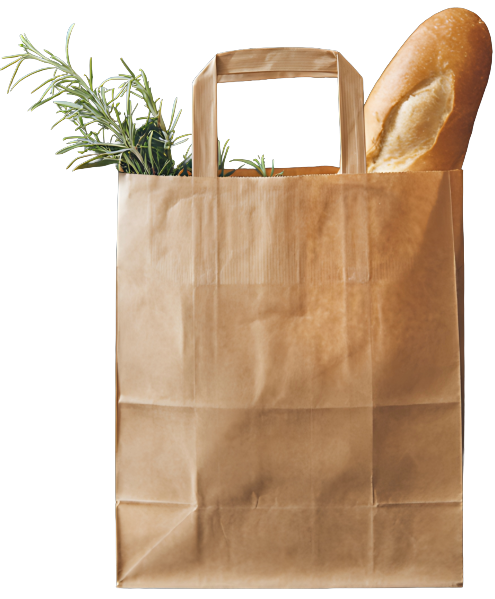
These stores may only provide customers with recycled paper carryout bags for a minimum charge of ten cents ($0.10) per bag at:
- Checkout counters
- Self-checkout kiosks
- In-store pickup
- Curbside delivery
- Home delivery
A paper carryout bag must meet the following requirements:
- Is accepted for recycling in curbside programs in a majority of households that have access to curbside recycling programs in the state.
- Has printed on the bag the name of the manufacturer, the country where the bag was manufactured, and the percentage of postconsumer content.
Effective January 1, 2028, recycled paper carryout bags must contain a minimum of 50% postconsumer recycled materials.
Visit PRC section 42280(e) for the complete list of requirements.
Exclusions
Stores are not allowed to provide customers with a carryout bag at the point of sale that is not a recycled paper bag. The following bag types are excluded from the definition of “carryout bag” and may only be distributed by stores as specified (PRC section 42280(a)):
- A bag provided by a pharmacy to a customer purchasing a prescription medication as defined by law (Business and Professions Code commencing with section 4000).
- A nonhandled bag used to protect a purchased item from damaging or contaminating other purchased items when placed in a recycled paper bag or a compostable plastic bag.
- A precheckout bag, as defined by law (PRC section 42281.2).
- A nonhandled bag that is designed to be placed over articles of clothing on a hanger, such as a garment bag used in dry cleaning or laundry services.
Do customers have to use paper carryout bags?
No, customers do not have to purchase and use paper carryout bags provided by a retail or grocery store. A goal of the legislation is to incentivize California consumers to bring their own reusable bag for carrying out store purchases. To reduce waste, shoppers may opt to use bags, such as synthetic or cotton tote bags, which can be washed and reused multiple times and may be sturdier for carrying heavy grocery items like canned goods and bottled beverages. These types of bags are available for purchase at many stores and businesses.
Pre-Checkout Bag Requirements
Effective January 1, 2025
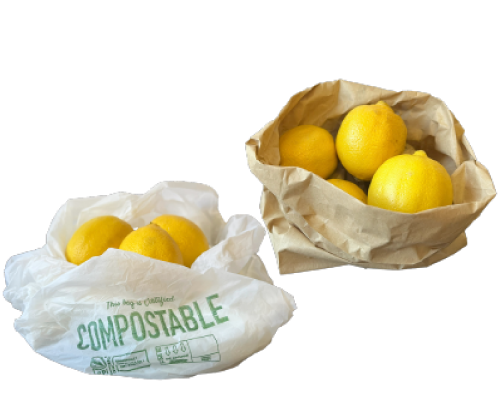
SB 1046 (Eggman, Chapter 991, Statutes of 2022) placed restrictions on the types of pre-checkout bags that most grocery stores, retail stores with a pharmacy, convenience stores, food marts, and liquor stores may provide to customers.
- Stores may only provide customers with pre-checkout bags that are:
- Recycled paper bags or
- “Compostable” bags that meet all statutory requirements
- Pre-checkout bags are provided to a customer before checkout to:
- Contain unwrapped items like bulk foods or loose produce.
- Protect a purchased item from damage or contamination.
Retail Store Pre-Check Out Bag Requirements Flyers
Keep your customers updated with the latest requirements.
A “compostable” pre-checkout bag provided to a customer must meet the following requirements:
- Comply with the standards described in PRC section 42357.5.
- Be eligible to be labeled with the terms “compostable” or “home compostable” pursuant to PRC section 42357.
- Have a minimum 15-inch mouth width.
Visit PRC section 42281.2 for the complete list of requirements.
SB 1046 Questions and Answers
Do customers have to use compostable or recycled paper pre-checkout bags?
No, customers do not have to use pre-checkout bags provided by a retail or grocery store. To reduce waste, shoppers may opt to bring their own reusable bags or containers for unwrapped food items, such as loose produce, nuts, grains, and bakery goods. When possible, shoppers can also “skip the bag” and place items, like oranges and bananas, directly in their shopping cart.
What stores are subject to these pre-checkout bag requirements?
Stores that may only provide customers with compostable or recycled paper pre-checkout bags include:
- Full-line, self-service retail stores with gross annual sales of at least $2 million that sell a line of dry groceries, canned goods, or nonfood items, and some perishable items.
- Large retail stores with a pharmacy that have at least 10,000 square feet of retail space and that generate sales or use tax.
- Convenience stores, food marts, or liquor stores that are engaged in the retail sale of a limited line of goods, generally including milk, bread, soda, and snack foods, and that hold a Type 20 or Type 21 license issued by the Department of Alcoholic Beverage Control.
View the definition of “store” in PRC section 42280(f) for more information about which stores must abide by the law.
What is the definition of a “pre-checkout bag”?
“Pre-checkout bag” is defined in PRC section 42281.2(b) as follows:
A bag provided to a customer before the customer reaches the point of sale, that is designed to protect a purchased item from damaging or contaminating other purchased items in a checkout bag, or to contain an unwrapped food item, such as, but not limited to, loose produce, meat or fish, nuts, grains, candy, and bakery goods.
A pre-checkout bag does not include a bag used to prepackage items prior to their arrival in a store.
Can I dispose of compostable pre-checkout bags in my organic waste bin?
Most jurisdictions in California do not allow compostable plastic film bags to be placed in organic waste collection bins or carts. Contact your local recycler or curbside program to learn more about the recycling and disposal options in your jurisdiction for managing compostable pre-checkout bags at the end of their useful life. Find your local recycling information on the I Recycle Smart webpage.
Due to the time it takes for these bags to break down and the difficulty in differentiating compostable vs. traditional plastic bags, very few compost facilities in California accept and compost them. Also, synthetic substances are not allowable inputs in compost that is certified organic for agricultural use under USDA standards.
Please Note: The Department of Resources Recycling and Recovery does not have enforcement authority over these laws. Consult with your legal counsel if you have any questions or concerns.
 Visit I Recycle Smart for
tips on how to reduce waste,
to learn about what you can recycle,
and find your local recycling information.
For more information, contact Plastics@calrecycle.ca.gov